what is attention residue, and why does it matter?

Attention residue is the mental lag that occurs when you switch from one task to another, leaving part of your focus stuck on the previous activity. This effect can make it harder to concentrate fully on what’s next. While the concept is widely discussed, research is still evolving on exactly how much it impacts everyday productivity.
Attention residue refers to the lingering thoughts and reduced focus that occur when you switch from one task to another, making it harder to fully engage with your new activity. This mental carryover can decrease productivity and make deep concentration more difficult, especially when switching between digital distractions and focused work.
key takeaways
- Attention residue is the leftover focus from a previous task that disrupts your ability to concentrate on new ones.
- Frequent task-switching, especially between digital apps, increases attention residue and reduces deep work.
- Simple steps—like silencing notifications or using screen time tools—can help reduce distractions and attention residue.
- The science behind attention residue is promising but still developing; strategies may work differently for everyone.
defining attention residue
Attention residue describes what happens when you switch tasks: your mind remains partly occupied with the previous activity, making it harder to focus on the next. The term was introduced by organizational psychologist Dr. Sophie Leroy in 2009. She found that people who frequently switch between tasks often bring incomplete thoughts or worries from one task into the next, hampering their ability to concentrate.
In practical terms, this means if you check a social media notification while working, some of your attention stays with that notification—even after you’ve returned to your main task. The more often you switch, the greater the residue and the harder it becomes to regain deep focus.
Apps like Pauza encourage you to spend more uninterrupted time away from your phone, which may help reduce attention residue by minimizing frequent digital task-switching.
how attention residue actually works
When you move from one task to another without fully finishing the first, your brain doesn’t instantly reset. Instead, part of your cognitive resources remain preoccupied. This is attention residue.
The effect is especially noticeable when switching between tasks that require different types of thinking—like pausing a work project to check messages, then trying to return to focused work. Your mind can replay unfinished business from the previous activity, making it harder to dive into the new one.
This isn’t just theoretical: Leroy’s research showed that people who were interrupted or switched tasks performed worse on subsequent tasks, likely due to lingering thoughts from what they’d just left behind.

what the evidence does (and doesn't) show
The idea of attention residue is supported by several lab studies, but there are limits to what we know. Dr. Leroy’s 2009 and 2010 studies demonstrated measurable drops in performance after task-switching, but these were controlled experiments—not real-world conditions.
There is agreement among researchers that frequent interruptions can reduce productivity and increase stress. However, there is less consensus about how much attention residue affects everyday life outside the lab. Most evidence comes from short-term studies, not long-term tracking.
Still, the effect seems relevant in our digital age, when frequent multitasking is common. Consider that the average internet user spends 2 hours and 21 minutes on social media every day (source: DataReportal, Digital 2025)—that’s many opportunities for distraction and mental carryover.
- Lab studies show short-term performance drops after task-switching.
- Real-world impact may vary from person to person.
- No large-scale studies yet confirm long-term effects.
how to reduce attention residue in daily life
You can’t eliminate attention residue entirely, but you can minimize it by designing your day to reduce unnecessary task-switching. Small changes in your phone habits and workspace can make a difference.
Start by turning off non-essential notifications (Settings > Notifications on iPhone) to limit interruptions. Use Focus or Do Not Disturb modes when you need to work deeply (Settings > Focus). Try batch-checking messages at set times instead of reacting instantly.
If you want to get concrete about your habits, a screen time calculator makes those hours concrete. Apps like Pauza let you track and reward stretches of uninterrupted time off your phone, helping you build healthier routines.
- Silence notifications for non-critical apps.
- Set specific times to check emails and messages.
- Use Focus or Do Not Disturb modes during deep work.
- Keep your phone in another room when possible.
- Try digital wellbeing apps to motivate phone-free periods.
common misunderstandings about attention residue
It’s easy to mix up attention residue with general distraction or procrastination, but they’re not the same. Attention residue is specifically about the lingering focus from a previous task—not just being distracted by something new.
Some believe that multitasking builds mental agility, but research suggests the opposite: frequent task-switching increases residue and reduces performance. Another myth is that short breaks always refresh you, but if those breaks involve switching to mentally demanding tasks (like social media), they can actually worsen attention residue.
Understanding this difference helps you choose breaks and routines that truly support your focus.
tools and next steps
If you want to experiment with reducing attention residue, start by tracking your own patterns. Use your iPhone’s built-in Screen Time (Settings > Screen Time) to review which apps interrupt you most often. Try setting app limits or scheduling phone-free blocks.
Pauza can support you in building streaks of focused, phone-free time—rewarding you with tokens and friendly challenges, rather than simply blocking apps. Your raw usage data stays on your device, and you can invite friends to bet on who will scroll less, making the process more engaging without risk.
Making even small changes to your notification settings or daily phone habits can help reduce attention residue and support deeper focus.
- Review your Screen Time stats weekly.
- Set app limits for your most-used distractions.
- Use apps like Pauza to motivate longer phone-free stretches.
- Schedule regular, tech-free breaks throughout your day.
by the numbers
- The average internet user spends 2 hours and 21 minutes on social media every day.— DataReportal, Digital 2025
If you want to try reducing attention residue, give Pauza a try on your iPhone. Small changes can add up to more focused, satisfying days.
Get Pauza on iPhone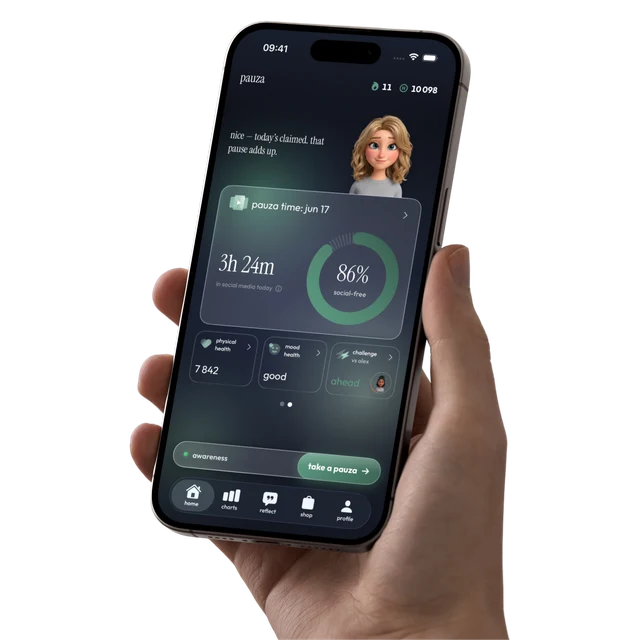
frequently asked questions
is attention residue the same as being distracted?
No. Attention residue is the leftover mental focus from a previous task, while distraction is any interruption or competing stimulus that diverts your attention.
does multitasking always cause attention residue?
Frequent multitasking increases the chance of attention residue, but some people are more affected than others. Switching between similar tasks may create less residue than switching between very different types.
can short breaks reduce attention residue?
Only sometimes. If your break involves a simple, relaxing activity, it can refresh your focus. But switching to a mentally demanding task (like social media) can actually make attention residue worse.
how do I know if attention residue is affecting me?
If you find it difficult to concentrate after checking your phone or switching tasks, or you notice lingering thoughts about what you just left, you may be experiencing attention residue.
what’s the best way to reduce attention residue on my iPhone?
Turn off non-critical notifications, use Focus or Do Not Disturb modes, and consider using digital wellbeing apps to create longer stretches of uninterrupted time.
are there any proven benefits to reducing attention residue?
Lab studies suggest that minimizing task-switching can improve focus and task performance, but more research is needed to confirm long-term real-world benefits.
free tools
- screen time calculator — see what your daily hours add up to over a year
- average screen time statistics — how your usage compares to the latest data
- phone habit test — a 2-minute check of your phone habits