Every screen-time term you'll run into — defined in plain English, about 40 words each, no jargon. Where we've written a full guide, it's linked under the definition. Feel free to quote any definition with a link to this page.
doomscrolling
Doomscrolling is compulsively scrolling through negative news and social feeds long after it stops being informative or useful. It's driven by the brain's threat-scanning instinct combined with infinite feeds that never give you a natural stopping point.
brain rot
Brain rot is internet slang for the perceived mental dulling that comes from overconsuming low-effort, short-form online content. Oxford University Press named it Word of the Year 2024. It's a cultural term, not a medical diagnosis.
dopamine detox
A dopamine detox is a deliberate break from high-stimulation activities — social media, games, junk food — to make ordinary life feel rewarding again. The name is scientifically loose (you can't detox a neurotransmitter), but the practice of scheduled abstinence is real and useful.
→ What a dopamine detox really does
digital detox
A digital detox is a defined period — an evening, a weekend, a vacation — during which you deliberately reduce or completely stop using digital devices. Unlike a dopamine detox, it targets the devices themselves rather than stimulation in general.
screen time
Screen time is the total time you spend looking at device screens — phone, tablet, computer, TV. On iPhone, Apple's built-in Screen Time feature measures it per app and per category, and third-party apps build on the same data.
phone addiction (problematic smartphone use)
Phone addiction — researchers prefer "problematic smartphone use" — is a compulsive pattern of phone checking and scrolling that persists despite interfering with sleep, work, or relationships. It is not an official clinical diagnosis, but validated scales exist to measure it.
nomophobia
Nomophobia ("no-mobile-phone phobia") is the anxiety or fear of being without your phone — a dead battery, no signal, or leaving it at home. The term came from a 2008 UK study and describes a feeling most heavy phone users recognise instantly.
phubbing
Phubbing (phone + snubbing) is ignoring the person in front of you in favour of your phone. Research links being phubbed to lower relationship satisfaction — it signals that whatever is on the screen matters more than the person present.
revenge bedtime procrastination
Revenge bedtime procrastination is sacrificing sleep to scroll or watch "just one more" because your day left no time that felt like your own. The "revenge" is against a schedule you don't control — paid for with tomorrow's energy.
infinite scroll
Infinite scroll is the interface pattern where new content loads endlessly as you swipe, removing every natural stopping point. Combined with algorithmic feeds, it's one of the main design reasons "checking one thing" turns into 40 minutes.
variable reward
A variable reward is an unpredictable payoff — sometimes a great post, sometimes nothing — delivered on an irregular schedule. It's the same mechanic that makes slot machines compulsive, and it's why pull-to-refresh and algorithmic feeds are so hard to put down.
FOMO and JOMO
FOMO (fear of missing out) is the anxiety that others are having rewarding experiences you're absent from — a major driver of compulsive feed checking. JOMO (joy of missing out) is its deliberate opposite: contentment with being offline.
grayscale mode
Grayscale mode turns your phone's screen black-and-white, making colourful apps noticeably less appealing. On iPhone it lives under Settings → Accessibility → Display & Text Size → Color Filters, and you can toggle it with a triple-click shortcut.
→ More iPhone settings that cut screen time
digital minimalism
Digital minimalism is a philosophy of technology use — popularised by Cal Newport's 2019 book — in which you keep only the digital tools that strongly support things you value, and happily drop everything else.
phone pickups
Phone pickups count how many times a day you wake or unlock your phone. It's a better habit signal than total hours: dozens of daily pickups usually mean automatic, unconscious checking rather than intentional use. iPhone shows pickups in the Screen Time dashboard.
app blocker
An app blocker is software that restricts access to chosen apps for a set time — from Apple's built-in App Limits to dedicated tools. Blockers vary in strictness; the common failure mode is that the user simply turns them off or deletes them.
→ Every screen time app compared
screen time challenge
A screen time challenge is a time-boxed competition to use your phone less, alone or against a friend. In Pauza, both sides stake tokens and whoever has the lower screen time when it ends wins the pot — accountability without money.
attention residue
Attention residue is the part of your focus that stays stuck on a previous task after you switch — the reason a "quick" phone check taxes the minutes that follow it. The term comes from research by organisational scholar Sophie Leroy.
Pauza rewards you with tokens for every minute you spend off social media — and lets you bet a friend that you'll scroll less. Free on iPhone.
Get Pauza on iPhone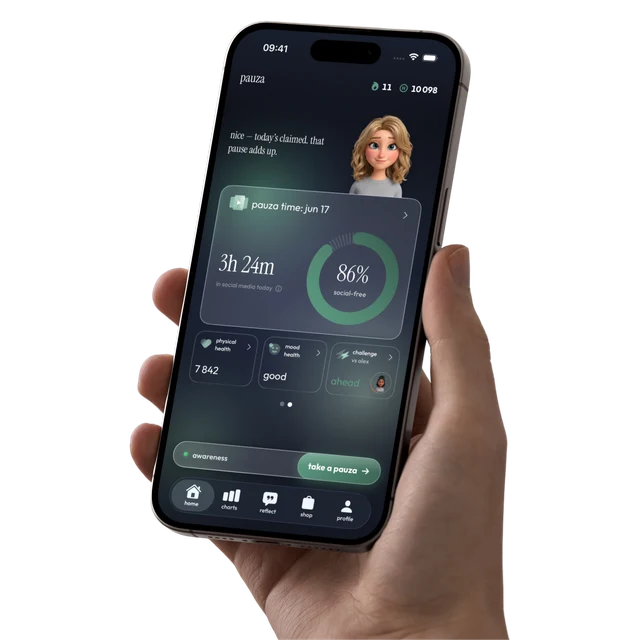
Related: screen time statistics 2026 · phone addiction test · the blog