screen time resolutions that don't fail by february

Most screen time resolutions fail by February because they rely on willpower alone. The real key is making your phone less tempting and your time off it more rewarding. Here’s how to set up your iPhone—and your mindset—for screen time resolutions that actually last.
To make screen time resolutions last, focus on changing your phone environment and routines, not just your intentions. Use iPhone settings, app limits, and social accountability to reduce temptation, and add simple rewards for time away from your screen to reinforce the habit.
key takeaways
- Change your phone's environment to reduce temptation, not just your mindset.
- Use iPhone’s built-in features to limit distracting apps and track real usage.
- Small, visible rewards and accountability with friends make habits stick.
- Most resolutions fail because they’re too vague or rely on willpower alone.
why most screen time resolutions fizzle out
Every January, millions set screen time resolutions, but by February, most have quietly given up. The culprit isn’t laziness—it’s the invisible design of our devices. Phones are engineered to demand attention, and habits built around them are deeply automatic. Simply vowing to ‘use my phone less’ rarely works against these cues.
The average internet user spends 2 hours and 21 minutes on social media each day, according to DataReportal. That’s not just a lack of discipline—it’s the result of apps built to maximize engagement. Without redesigning how your phone fits into your life, even the best intentions slip.
A screen time calculator can help you visualize just how much time these small scrolls add up to. Seeing the actual numbers makes the habit concrete and harder to ignore. Apps like Pauza can add a layer of visibility and gentle accountability, but the foundation is understanding why willpower alone rarely wins.
- Phones are designed for constant engagement, making self-control harder.
- Vague goals (‘use it less’) don’t change your environment or habits.
- Most people underestimate their true daily screen time.
make your phone less tempting, step by step
Before you build a new routine, change your phone’s environment. Research shows that even seeing your phone can trigger the urge to check it. The goal is to add small ‘speed bumps’ between you and the habit loop.
Start by moving distracting apps off your home screen. On iPhone, press and hold an app icon, select ‘Remove from Home Screen’ (not delete), and keep only essential tools visible. Turn off non-essential notifications in Settings > Notifications for each app. Set your display to grayscale (Settings > Accessibility > Display & Text Size > Color Filters) to make apps less visually rewarding.
These steps lower the number of cues that trigger mindless scrolling. Combine this with a physical change—like charging your phone outside your bedroom or keeping it in a bag during meals—to break automatic checking cycles.
- Move social and entertainment apps into folders or off your home screen.
- Disable non-critical notifications for every app.
- Switch to grayscale mode to reduce visual triggers.
- Charge your phone outside your bedroom at night.

use your iphone’s hidden tools to set boundaries
Your iPhone has built-in features that help you stick to screen time resolutions—if you set them up thoughtfully. ‘App Limits’ and ‘Downtime’ (Settings > Screen Time) can block access to specific apps or groups at chosen times. Start by reviewing your Screen Time report in Settings > Screen Time > See All Activity for a true picture of your use.
Set app limits for your biggest time drains, like social media or games. Be realistic—cutting back by 30 minutes a day is more sustainable than trying to quit cold turkey. Use ‘Downtime’ to create phone-free windows, such as during meals or just before bed. Enable ‘Communication Limits’ to restrict who can contact you during these times.
Remember, these features are only helpful if you make bypassing them inconvenient. Use a Screen Time passcode that only a trusted friend or family member knows, or write it down and store it out of reach.
add positive friction: make time off your phone feel good
Most resolutions focus on blocking or restricting, but adding positive rewards makes new habits stick. Choose one enjoyable activity to immediately follow each phone-free period, like stepping outside, making tea, or reading a few pages of a book. The key is to create a positive association with time away from your device.
Apps like Pauza can help here: they turn minutes spent off your phone into tokens, streaks, or playful challenges with friends. These small rewards aren’t about prizes, but about making your progress visible and social. When you feel good about your effort, you’re more likely to repeat it.
If you prefer analog rewards, mark a calendar for every phone-free hour or keep a simple journal. The act of tracking itself provides a sense of accomplishment.
- Pair phone-free time with a favorite activity.
- Track your streaks or progress visually (calendar, journal, app).
- Try friendly bets with a partner—lowest screen time wins a non-monetary prize.
social accountability: why it works better than willpower
Accountability to others makes screen time resolutions more effective. Sharing your goal with a friend or family member makes you more likely to stick with it—even if there’s no formal prize. Consider setting up a weekly check-in, where you compare your screen time or share your best and worst days.
Some apps let you set up friendly challenges, so you and a friend can ‘bet’ who will scroll less (without real money involved). This light competition can keep things fun instead of punitive. Knowing someone else will see your numbers adds a powerful nudge.
If you’re in a group chat or online community, suggest a shared goal: for example, everyone tries to cut 10% off their ‘average screen time’ for a week. Celebrating small wins together is more motivating than going it alone.
what to do when you slip: rebuilding after a setback
Even with the best tools and intentions, you’ll have days when your screen time creeps up. The trick is not to treat these as failures, but as normal parts of building a new habit. Instead of starting over, review what triggered the slip—was it boredom, stress, or a specific app?
Use your Screen Time report to spot patterns. Did your usage spike on weekends, during late nights, or after certain notifications? Make one small change in response: move an app, set a new limit, or schedule a different activity for your weak spot.
Progress is rarely linear. By focusing on adjusting your environment and celebrating small improvements, you make your screen time resolutions resilient for the long term.
by the numbers
- The average internet user spends 2 hours and 21 minutes on social media every day.— DataReportal, Digital 2025
Ready to make your screen time resolutions stick? Try Pauza on your iPhone for a calmer, more mindful digital routine.
Get Pauza on iPhone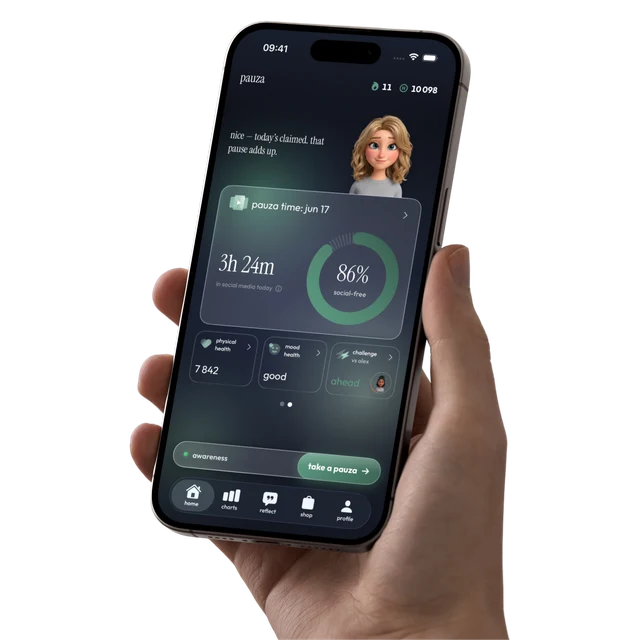
frequently asked questions
How do I check my iPhone screen time accurately?
Go to Settings > Screen Time > See All Activity. Here, you can view your daily and weekly totals, as well as which apps you use most.
What’s a realistic daily screen time goal?
Start by reducing your current average by 15–30 minutes. Extreme cuts are hard to maintain; small, steady changes are more sustainable.
Can I set app limits for specific times of day?
Yes. In Settings > Screen Time > App Limits, you can set daily time limits for specific apps. Use ‘Downtime’ to block all apps except essentials during certain hours.
What if I need to override a limit for work or emergencies?
Screen Time allows you to extend limits if needed, but try to make this the exception. Use a passcode only you or a trusted friend knows to add friction.
How do I make phone-free time feel rewarding?
Pair it with a favorite activity or use a tracking app that turns time off-screen into visible progress. Celebrating small streaks builds momentum.
Do I need a special app to keep screen time resolutions?
Not necessarily. iPhone’s built-in tools are powerful, but apps like Pauza add extra layers of motivation, gentle rewards, and accountability features.
free tools
- screen time calculator — see what your daily hours add up to over a year
- average screen time statistics — how your usage compares to the latest data
- phone habit test — a 2-minute check of your phone habits