average screen time in 2026: what the data really says

People spend an average of 6 hours and 38 minutes online across all devices each day (DataReportal, Digital 2025). This figure shapes how we work, connect, and unwind, but it also raises important questions about balance. Understanding the latest average screen time statistics can help you make informed choices about your digital routine.
Average screen time statistics show that people spend about 6 hours and 38 minutes online daily across all devices, with social media alone accounting for 2 hours and 21 minutes. U.S. teens report even higher usage, averaging 9 hours per day on entertainment media, highlighting widespread and increasing digital engagement.
key takeaways
- The average person spends over 6 hours online each day.
- Nearly half of U.S. teens say they are online almost constantly.
- Tweens and teens often have even higher daily screen media use.
- Small changes can help you take back control of your screen time.
the headline numbers: average screen time statistics
Recent data highlights just how much time we spend with screens. The average internet user now spends 2 hours and 21 minutes every day on social media alone, while total daily online time across all devices reaches 6 hours and 38 minutes (DataReportal, Digital 2025). For younger people, the numbers are even higher: U.S. teens report about 9 hours a day using entertainment media, excluding schoolwork (Common Sense Media).
These numbers illustrate that digital devices are firmly embedded in daily routines, shaping how we communicate, learn, and relax. If you’re curious about how your habits compare, tracking your own screen time can be a revealing first step.
Apps like Pauza can help you see your daily patterns and gently encourage time away from your phone, but the data tells us that almost everyone is spending significant time online.
- Average daily online time: 6 hours 38 minutes
- Average daily social media use: 2 hours 21 minutes
- Teens' entertainment media use: about 9 hours/day
- Tweens' screen media use: 5 hours 33 minutes/day
what’s driving screen time higher
Several factors contribute to rising screen time. Mobile devices, social media platforms, and streaming services make it easier than ever to stay connected and entertained. The typical social media user now actively uses 6.5 different platforms each month (DataReportal, Digital 2025), making it easy for minutes to add up without noticing.
Work and school expectations have also shifted online, especially since the pandemic. Messaging apps, remote learning, and digital collaboration tools mean that screens are essential for productivity as well as leisure.
Many apps are designed to capture attention with notifications and endless feeds, encouraging more frequent and longer sessions. Understanding these drivers can help you make choices that align with your own goals.
- Widespread use of multiple social platforms
- Remote work and digital schoolwork
- Apps designed for maximum engagement

who is most affected by high screen time
Young people experience some of the highest screen exposure. Common Sense Media reports that U.S. teens use about 9 hours of entertainment media per day, while tweens (ages 8–12) average 5 hours and 33 minutes daily. Nearly half of U.S. teens (46%) say they are online almost constantly, a dramatic increase over the past decade (Pew Research Center, 2024).
Easy access is a major factor: 95% of U.S. teens have access to a smartphone, making it possible to go online virtually anytime (Pew Research Center, 2024). For adults, work-related screen time can also be substantial, often blending with personal use.
These patterns suggest that strategies for healthy screen time should be tailored by age and lifestyle. Parents, educators, and individuals all play a role in shaping balanced habits.
what does this mean for daily life
Spending hours each day online isn’t inherently negative, but it can crowd out time for offline activities, sleep, and real-world social connections. Many people don’t realize how quickly small digital check-ins add up to hours.
Screen time can affect sleep quality, concentration, and even mood. Recognizing your own habits is the first step: iPhone users can check their average daily and weekly screen time in Settings > Screen Time. If you notice patterns you’d like to change, there are concrete steps you can take.
Using an app like Pauza can help you set gentle boundaries, turn time away from your phone into rewards, and even challenge friends to reduce screen time together.
how to take control: practical steps for iPhone users
Small, specific changes can make a big difference. Here are practical steps you can try right away:
1. Review your screen time: Go to Settings > Screen Time on your iPhone to see a breakdown of your daily and weekly activity. Identify your top-used apps.
2. Set app limits: In Screen Time, tap 'App Limits' and set daily limits for social media or entertainment apps. Start with a small reduction—just 10–15 minutes less per day can add up.
3. Use Downtime: Schedule Downtime in Screen Time to automatically block distractions during meals, work, or before bed.
4. Turn off non-essential notifications: Go to Settings > Notifications and disable alerts for apps that interrupt your flow.
5. Try focus modes: Use Focus in Settings to filter notifications and apps based on your current activity (e.g., work, sleep, personal time).
6. Explore mindful apps: Tools like Pauza encourage you to take breaks, reward time spent off your phone, and make it easier to stick with new habits—without tracking your personal data off-device.
Building a new routine will take time, but even small, consistent changes can help you reclaim your attention and time.
- Check your daily and weekly screen time in Settings
- Set or adjust app limits for your biggest time-sinks
- Use Downtime or Focus modes to create tech-free zones
- Try a digital wellbeing app for added motivation
by the numbers
- People spend an average of 6 hours and 38 minutes online across all devices each day.— DataReportal, Digital 2025
- The average internet user spends 2 hours and 21 minutes on social media every day.— DataReportal, Digital 2025
- Nearly half of U.S. teens (46%) say they are online almost constantly — roughly double the share a decade ago.— Pew Research Center, 2024
- 95% of U.S. teens have access to a smartphone.— Pew Research Center, 2024
- U.S. teens use an average of about 9 hours of entertainment media per day, not counting schoolwork.— Common Sense Media
- Tweens aged 8–12 average about 5 hours and 33 minutes of screen media per day.— Common Sense Media
- The typical social media user actively uses 6.5 different platforms each month.— DataReportal, Digital 2025
If you're curious about your own habits, try Pauza on your iPhone and see how small changes can add up.
Get Pauza on iPhone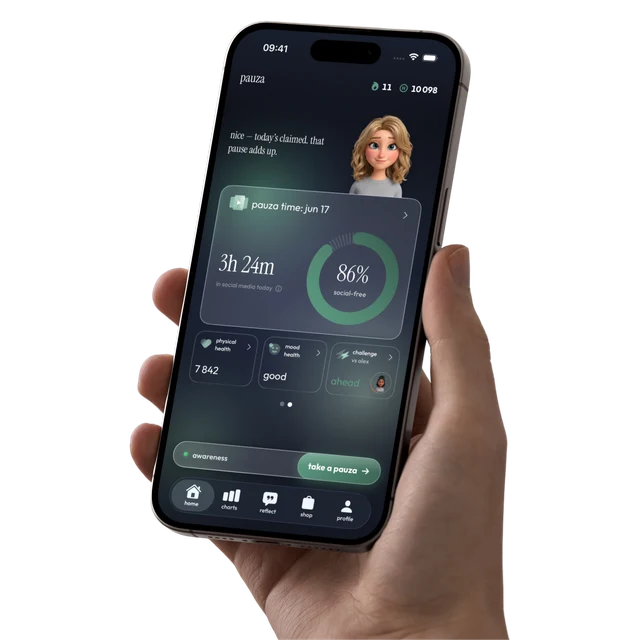
frequently asked questions
What is considered 'average' screen time in 2026?
Recent data shows the average person spends 6 hours and 38 minutes online daily across all devices, with social media accounting for 2 hours and 21 minutes.
How much screen time do teenagers have compared to adults?
U.S. teens spend about 9 hours a day on entertainment media, not including schoolwork, which is much higher than the overall average.
Does high screen time always mean something negative?
Not always. Screen time can support learning, work, and socializing, but too much can affect sleep, focus, and offline relationships.
How can I check my own screen time on iPhone?
Go to Settings > Screen Time on your iPhone to see how much time you spend on different apps and categories each day and week.
Are there easy ways to cut back on screen time?
Start by setting small daily limits on your most used apps, turning off non-essential notifications, and using focus or downtime features.
What makes Pauza different from other screen time apps?
Pauza rewards you for time spent away from your phone with in-app tokens and lets you challenge friends to lower your screen time together, all while keeping your raw data on your device.
free tools
- screen time calculator — see what your daily hours add up to over a year
- average screen time statistics — how your usage compares to the latest data
- phone habit test — a 2-minute check of your phone habits